“My father equally loved his new adopted home in Canada while never, ever forgetting his proud Armenian heritage,” said a son of one orphan who arrived in Georgetown a century ago”
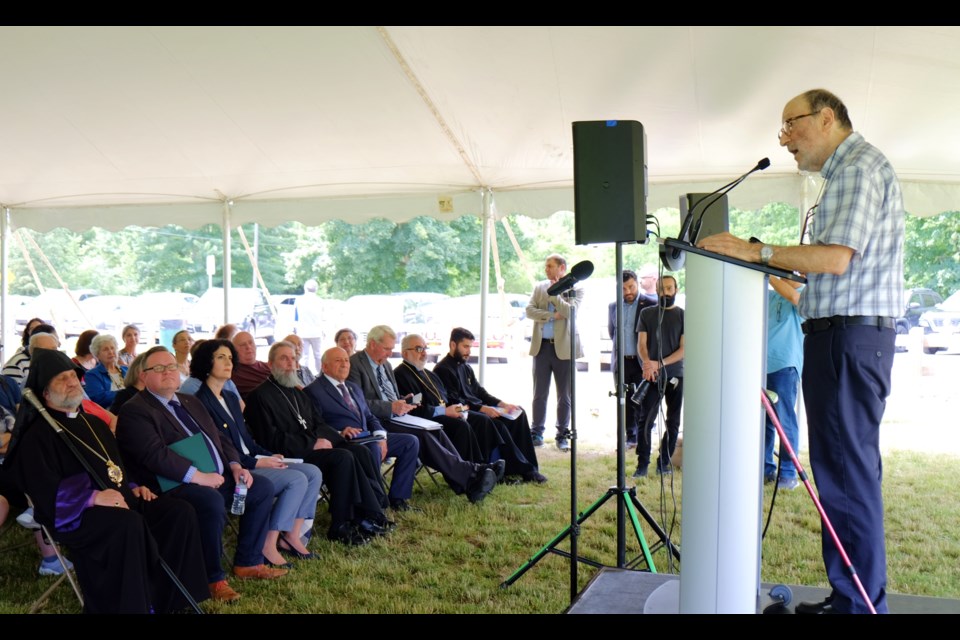
Their voices carry on through their descendants, and through them their language has, once again, reverberated in Cedarvale Park in Georgetown.
Hundreds of Armenian-Canadians, and several locals, gathered at the former farm on the weekend to mark 100 years since the arrival of the Armenian orphans known as the Georgetown Boys. Present were many of their descendants. Some of them took the stage to share stories about their parents and grandparents. The event was held by the Sara Corning Centre for Genocide Education.
“My father equally loved his new adopted home in Canada while never, ever forgetting his proud Armenian heritage,” Hamilton City Councillor Tom Jackson said of his father, Missak Toumajian.
Toumajian and 108 other boy orphans survived the Armenian Genocide of 1915. They, and 39 girls and women, escaped state-sponsored carnage at the hands of the Ottoman Empire. The first group of boys arrived at Cedarvale Farm on July 1, 1923 to learn how to become good farmers and citizens.
Though their homes in what’s now known as Turkey were destroyed, they found new ones in Canada through the charity of Canadians and aid organizations. This “noble experiment,” as it has been dubbed, set the tone for Canada’s humanitarian tradition.
Through grit, good humour and keeping the culture alive, they carved out a place for the Armenian community in Canada. Some loyally served in the Canadian Armed Forces, others became entrepreneurs and many, unfortunately, went their own way never to be heard from again.

They built a better life for their offspring. While Jackson is a politician, Bob Adourian is a Toronto-based lawyer and Lorne Shirinian is a professor emeritus at the Royal Military College.
Adourian – whose father Pavloss and uncle Onnig came with the first group of 50 Georgetown Boys in 1923 – remembers the orphans as being “fun-loving.”
“They loved games, and I benefited from that,” Adourian told the gathered crowd. The games he remembers are euchre, cribbage, horseshoes and the quintessentially Canadian game of crokinole, among others.
But raising the family wasn’t always fun and games. The genocide deprived the then-new Canadians of proper education. They only got a little bit of one in Georgetown. Adourian’s Cedarvale Farm elders instilled in him the importance of not taking education for granted.
“And let me tell you what, my parents reminded me of that at least once a day,” Adourian recalled. “They wanted to make sure that their families never missed a meal and never were hungry the way they were when they were growing up.”
Lorne Shirinian remembers his parents and their fellow alumni similarly.
“There were often parties of up to 20 in our backyard on Sunday afternoons,” he told the crowd.
Shirinian’s parents were Georgetown Boy Mampre Shirinian and Georgetown Girl Mariam Mazmanian. Her brother, Ardeshess, was also a Georgetown Boy.
“Everyone would form a circle and dance. The women would always try to pull me in. My father saved me by picking me up and dancing with me in his arms. Imagine what our neighbours thought of this.”
Several other distinguished guests made an appearance. The Armenian Ambassador to Canada, Anahit Harutyunyan, said that the history of Cedarvale Park reminded her “of the power of empathy and the profound impact that one nation can have on the lives of those in need.”
Councillor Bob Inglis, MPP Aris Babikian, MPs Brian May and Michael Chong also delivered remarks.


Leave a Reply