The names of Acton’s war dead are set in stone on the town’s local cenotaph. Many will gather at the memorial to remember them this Saturday starting at 10:45 a.m.
But few, if any, will recall how Acton flew into battle for Canada in the Second World War.
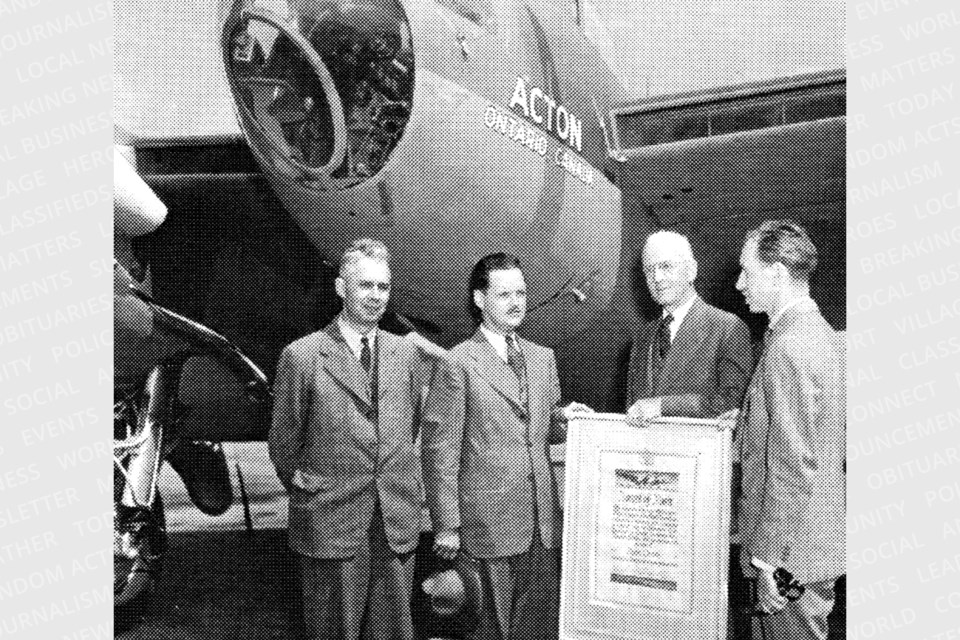
In July 1943, five fighter aircraft models called the de Havilland Mosquito rolled out onto the tarmac in Toronto. They were christened with the names of communities that excelled in promoting victory loans – money lent to the government to fight the war.
One of the planes had “Acton, Ontario, Canada” emblazoned on its nose.
“The honour of having a bomber named after Acton was a sense of pride for the community, showing that small villages and towns were dedicated and committed to supporting the war effort,” local historian Scott Brooks explained.
As Acton was a village of between 2,000 and 3,000 people at the time, this was not a small feat. It was the tiniest municipality among the batch of five. Acton was also the only Ontario community to receive the honour on that day. The other four were New Glasgow (just under 10,000 people at the time), Moose Jaw (about 20,000), Saskatoon (70,000) and Vancouver (about 275,000).
“It was seen as showing extra support for their men and women overseas. And there were often quite a few parades that would be held,” Brooks told HaltonHillsToday.
It’s perhaps appropriate that a Mozzie, as the aircraft came to be known, was picked to carry Acton’s name. Much like the town, the plane was modest in design.
Many skeptics didn’t give it a snowball’s chance in hell. The majority of the plane was made out of wood rather than the more commonly used, and stronger, armour of aluminum. “The Wooden Wonder,” as it was nicknamed, was smaller than most bombers of the era. It had a crew of two pilots.
But much like Acton and its successful victory loan campaign, it punched well above its weight. The smaller airframe and lightweight materials meant the plane was faster, and could fly further, than most other aircraft in the Allied inventory. This made the Mosquito ideal for perilous, deep-penetration operations behind enemy lines.
Several pieces of media highlight its capabilities and impact on British and Canadian cultures. The movie 633 Squadron is a fictional account of Mosquito pilots in the war. The Purple Plain is a story about a Canadian Mozzie pilot, played by Gregory Peck, in the Burma campaign. A short story called The Shepherd is a tale about a Mosquito guiding a lost pilot home in time for Christmas.
“No offensive aircraft of the war is more deadly and more sought-after by combat pilots than the Mosquito,” Ralph Bell of de Havilland Canada said at the 1943 christening ceremony.
The atmosphere was electric during the introduction of the five aircraft. Thousands of the company’s plant workers gathered to watch the planes fly.
Representatives from Acton were present and accepted the “Award of Merit” on behalf of the village.
Acton, Ontario, Canada, flew to England the following August. It took 14 hours for it to cross the Atlantic Ocean – an impressive record owing to the plane’s unique speed. It’s difficult to ascertain what sort of service the plane had, but Brooks has some small snapshots.
“Overall, the plane carried out missions over Germany. It actually survived the war,” Brooks said. “After the war, it was used for training.”


Leave a Reply