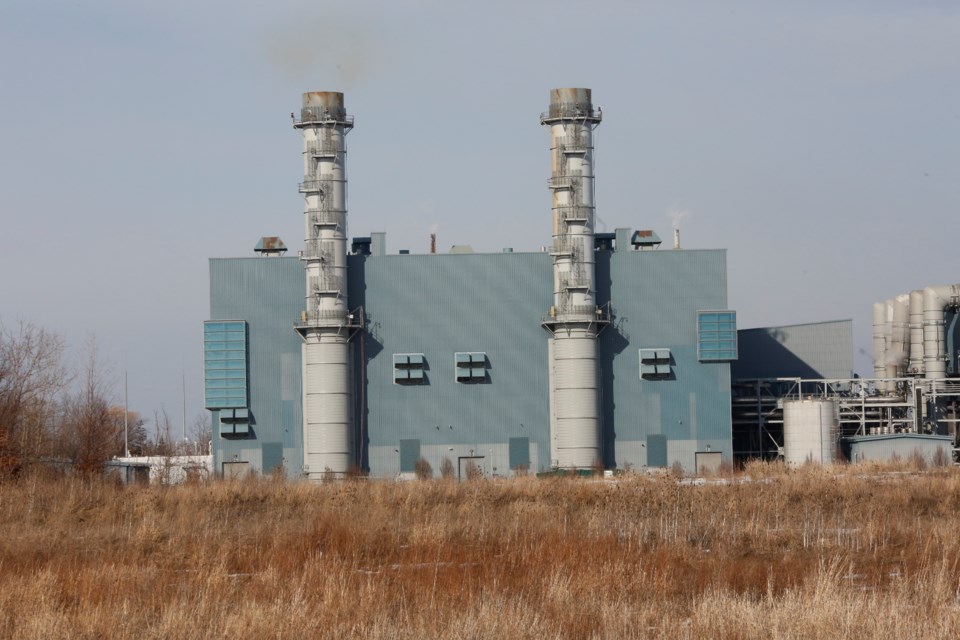
Atura Power has completed testing to determine whether hydrogen blending technology is feasible at its Halton Hills generation station.
The local energy producer at Sixth Line and Steeles Avenue, the Independent Electricity Systems Operator and Province of Ontario are betting big on hydrogen as a way to decarbonize the grid and create a new energy economy.
With $4 million from the government’s Hydrogen Innovation Fund, existing infrastructure at the local plant was retrofitted for the tech, colloquially referred to as ‘skids.’ Over the course of three weeks, blending tests were methodically conducted for a two-fold goal: to verify if the technology works with Atura’s systems and to test the effectiveness of hydrogen blending in generating electricity.

“A lot of the testing was of the instrumentation and the data signals,” said Project Manager Karan Goswami, explaining they focused on the equipment that provides information to the control room, such as signals from the valves to the controls, temperature sensors and flow sensors.
In the other part of the test, the company generated electricity using hydrogen blending in what Goswami calls “a live commercial test.”
During that time, residents may not have realized that their electricity was partially generated using hydrogen without any reported incidents. This was even during the summer’s heat waves, when the province saw some of the highest air conditioning usage in the year.
“It was successful in that front as well,” Goswami said. “We’ve collected all of the data at this point. We’ll analyze it and then provide that feedback to the IESO on what we saw, what we found and we’ll continue the conversation with them.”
The test represents a significant step in Premier Doug Ford government’s push for hydrogen blending. With electricity demand projected to rise by 75 per cent across Ontario by 2050, the government is looking to reduce costs and increase supply, all the while lowering greenhouse gas (GHG) emissions.
To that end, the province intends to create what it calls a low-carbon hydrogen economy. The goal of the economy is, according to a 2022 report, “about clearing the path and laying the groundwork to support the private sector to take the lead in growing the low-carbon hydrogen economy.”
“Hydrogen could make up about 30 per cent of the country’s fuels and feedstock by 2050, create about 350,000 jobs and remove up to 190 megatons of GHG emissions per year, with both domestic and international market opportunities,” the report elaborates, citing Natural Resources Canada.
But David Smith, a member of the environmental group Halton Hills Climate Action and a retired electrical engineer, is not convinced by the rosy picture painted by the province and Atura Power.
The company is building an electrolyzer at the Sir Adam Beck hydroelectric generating station in Niagara Falls, which will be used for separating hydrogen molecules from water, producing the gas. Atura hopes to become the supplier of this green hydrogen, known as such because the electrolyzer will be powered using hydroelectric power, a zero-emission method, across the province.
To Smith, storing hydrogen for use when needed makes sense, but he remains skeptical of its ability to decarbonize the grid.
“There are other technologies that I’d also like to see the investment in that are really important, such as batteries and solar and wind,” he said.
“I can see a role for hydrogen, but this doesn’t quite seem like it fits. The question that I would ask: is this really about greenwashing, or is there a longer-term strategy at play?”
Experts say hydrogen has enormous potential to reduce greenhouse gas emissions. Burning it merely produces water vapour. However, because hydrogen is significantly less energy-dense than natural gas, it must be blended with it in order to generate electricity efficiently.
Numerous studies indicate at most, hydrogen can comprise no more than about 20 per cent of a natural gas blend before significant reductions in energy output occur, and such a proportion can only reduce GHG emissions by six to seven per cent.
These limitations are acknowledged in a report by the IESO, which further notes that challenges remain with storage, transportation, costs and hydrogen production. Electrolyzer tech is in its infancy.
Hydrogen can potentially, as stated by the IESO, embrittle metals used for storage and delivery (like pipelines and truck tanks). Considerable investment in research and development will be required to upgrade existing technologies to meet these challenges.
“As part of an all-of-the-above approach to meeting rising demand for electricity, the IESO is looking to learn, test, and discover what benefits hydrogen can bring to Ontario’s grid,” IESO spokesperson Michael Dodsworth told HaltonHillsToday in an emailed statement.
“Through the Hydrogen Innovation Fund, the IESO and project proponents are testing existing and emerging technologies to determine how low-carbon hydrogen, produced here in Ontario by our reliable and affordable grid, can support the reliability, affordability and sustainability of our electricity system.”
“Any new technology needs a lot of effort to really get more efficient. And it starts with demonstrations like this,” Goswami said while acknowledging the concerns of environmentalist groups.
“We test out the technology, we test out the idea, we understand where the pitfalls are so we know where to focus on next.”


Leave a Reply