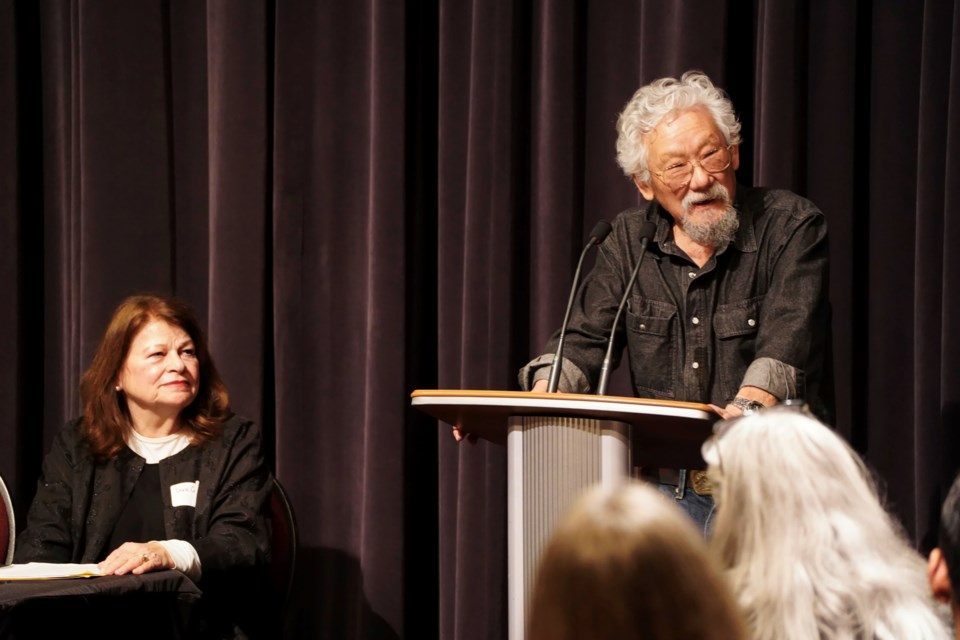
Internationally-renowned environmentalists David Suzuki and Tara Cullis issued several dire warnings during a local visit Monday.
The couple was at the FirstOntario Arts Centre as part of their Stronger Together Tour.
Their candid remarks were less a warning about what’s to come and more of an alarm about what is happening now; that climate change is here. Their overall message to the community was a mix of realism and hope through empowerment, namely, that politicians aren’t going to be the ones to save humanity.
The ones to do that are those at the grassroots level.
“There are nine of these critical areas that we, like all other animals, have to live within in order to sustain ourselves indefinitely,” Suzuki told the gathered crowd of politicians and environmental groups.
20260316suzukimt
David Suzuki listens intently as an attendee speaks to him and Tara Cullis. . Mansoor Tanweer/MiltonToday
The critical areas he was referencing were conceived by Swedish scientist Dr. Johann Rockström. These ‘planetary boundaries’ are, in simple terms, redlines that, if crossed, would spell disaster for the planet.
Said Suziki, “I attended a meeting in New York where Johann announced that we have passed six of the nine boundaries. If we pass even one, we should be shitting bricks.”
“A long time ago, Al Gore was vice president and David asked him how you could support politicians like him. And his answer was instructive. He said, ‘Don’t look to politicians like me for leadership. We can’t get ahead of the public, or we’d be out of office,’” Cullis said in her address.
Suzuki also took aim at Milton’s long-standing status as one of Canada’s fastest-growing municipality. “You shouldn’t celebrate that,” he said, alluding to the environmental challenges that come with growth.
The focus of the Stronger Together Tour wasn’t limited to doom and gloom. The couple, accompanied by several other speakers, treated the gathering as a town hall at times, hoping to take suggestions from the audience on how to build a brighter future.
Accompanying Suzuki and Cullis were:
Chief Margaret Sault of the Mississaugas of the Credit.
Milton Mayor Gord Krantz.
Executive Director of the David Suzuki Foundation, Pierre Iachetti.
Co-Chair of the Canadian Association of Physicians for the Environment, Dr. Mili Roy.
Sheila Murray, who co-founded Community Resilience to Extreme Weather.
Halton Region’s executive lead on climate change response and sustainability, Lisa Kohler.
Last year, in an interview with iPolitics, Suzuki stated bluntly that “it’s too late” for humanity to reverse climate change. Last January, German scientists revealed one of the most grim warnings yet. The European Centre for Medium-Range Weather Forecasts (ECMWF) published a report saying that global temperatures have hit the 1.5 degree Celsius mark above pre-industrial levels for the first time. The Paris Climate Agreement, which Canada is a signatory to, aims to limit global temperatures to well below 2 degrees Celsius, preferably no higher than 1.5 degrees.
As global temperatures tend to fluctuate, the 1.5-degree limit breach has not yet become the norm. However, the ECMWF estimates that this could become reality by the end of the decade.
“We’re going to reach 3 degrees by 2050. Humans have never lived under those conditions, ever. We’re in total chaos,” Suzuki told MiltonToday, noting extreme weather events such as wildfires, floods, storms and heat domes add to the stakes.
Keeping this in mind, he expressed frustration towards Prime Minister Mark Carney investing in the petroleum industry, believing that Canada should become, as stated by the PM, “an energy superpower.”
“He’s just wrong,” Suzuki said. “Other countries are moving ahead with renewables and we’re getting left behind,” Cullis echoed her husband.
MP Kristina Tesser Derksen, who was present at the meeting, emphasized the tightrope the prime minister has to walk. On the one hand, she said, Carney feels he needs to forge ahead with protecting Canada’s energy interests in the wake of US President Donald Trump’s policies, while also balancing the need for clean technology.
“We’ve got some very clear and present dangers as far as our economic sovereignty and building up our own internal economies and industries that need to be addressed. They can be done in a climate-sustainable way,” Tesser Derksen told MiltonToday.
The Milton stop of the Stronger Together was brought in partnership with numerous organizations like Sustainable Milton, Green Burlington, Credit Valley Conservation, Community Development Halton, Ontario Climate Emergency Campaign and Halton Hills Climate Action.
Members of Milton and Halton Hills Town councils were also present, including Mayor Ann Lawlor, Chantal Garneau, Jane Fogal, Sameera Ali, Colin Best and George Minakakis.


Leave a Reply